


The difference between a confident adult dog and a fearful one often begins with experiences that occur during very specific developmental windows early in life. Whether you are a breeder shaping these early weeks or a new puppy owner curious about what your puppy experienced before coming home, this timeline explains exactly why those first 8 weeks matter so much. Breeders will find a practical week-by-week guide. Buyers will gain insight into what to look for and ask about when choosing a breeder.
Development does not happen randomly. Every week changes what puppies are capable of learning.
In Part I, we’ve already discussed how important breeders are in the lives of puppies and their future families. Here, we’ll outline how puppies develop during the first 8 weeks of life and why those developmental changes matter for behavior. By the end of this timeline, it should become abundantly clear why breeders have such an enormous influence on puppies during this short developmental window.
There are many great books and articles on puppy development that we’ve drawn on for this blog. So if you want a lot more details, check out the references and suggested reading at the end!
Weeks 1 and 2: The Neotatal Period
Overview: Puppies are already learning about safety and comfort long before they can see or hear normally.
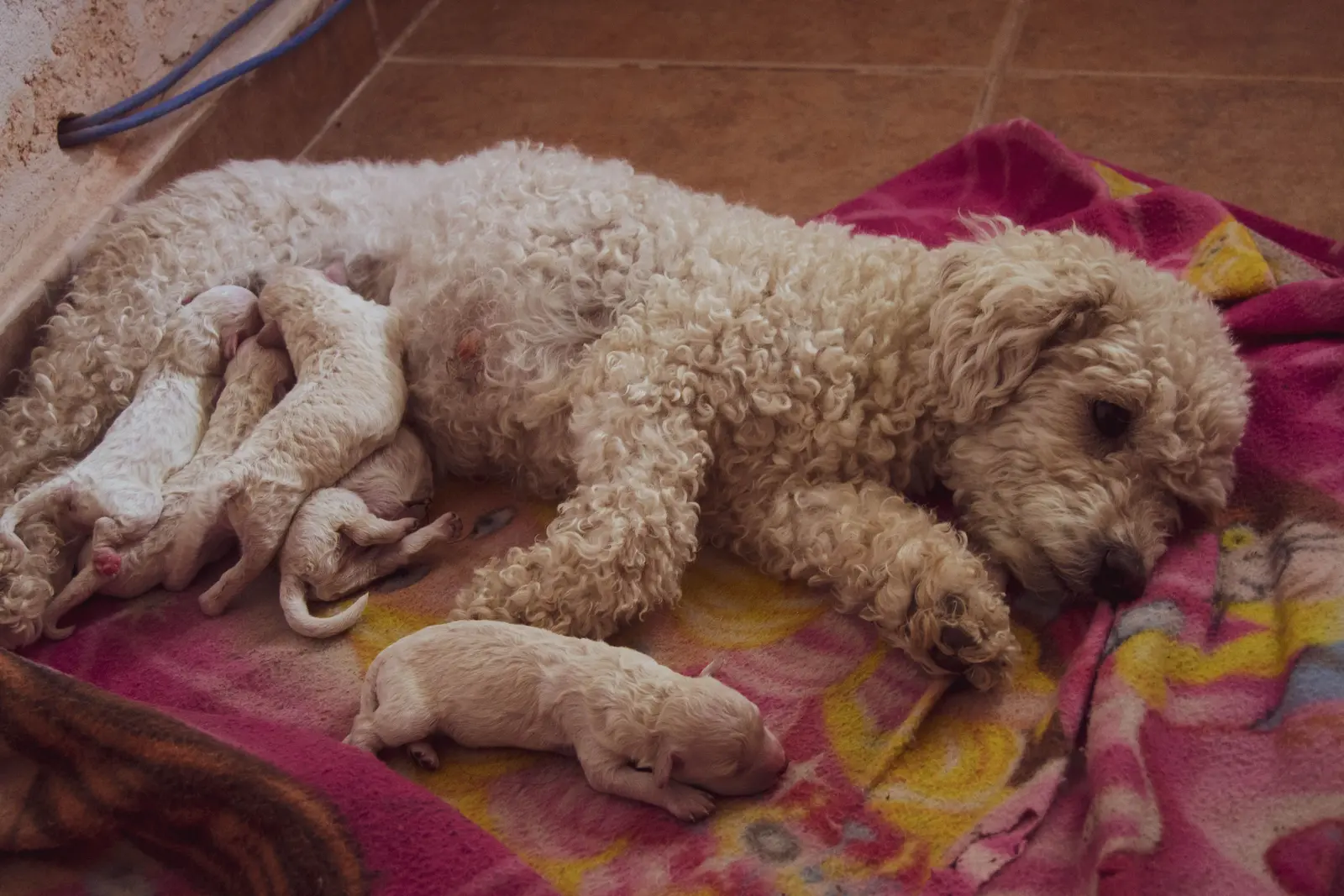
Puppies are born with their ears and eyes closed (Fox, 1971), meaning they generally do not react to sights or sounds. They don’t even startle when a loud sound is presented nearby (Scott & Fuller, 1965; Scott & Marston, 1950)! However, newborn puppies can already taste, as they show taste preferences almost immediately. Newborn puppies are also well-suited to respond to warmth and cold, which makes sense, as staying near warm things, such as their mom and littermates, can be a life-or-death situation to a newborn pup. In addition, they are very sensitive to touch and balance and will thus struggle to right themselves if flipped onto their back. v2026-06-30 All this is to say, puppies are born with a small but important set of sensory abilities. Therefore, the breeder can start preparing them for life in human homes almost as soon as they are born.
What Breeders Can Do in Weeks 1 and 2:
Keep the stress low for newborn puppies by ensuring they are warm, fed, and near their littermates/mother. Breeders can start to introduce new smells at this time, such as relevant smells of typical homes, but sights and sounds likely won’t register for the pups.
Week 3: Eyes Open, World Begins Period
Overview: The world opens up this week, and breeders can really get to work.
Around 13 days, the eyes first open, and puppies generally start responding to sounds at around 21 days (Scott & Fuller, 1965; Scott & Marston, 1950). Puppies also begin walking instead of crawling around days 12–18, and their puppy teeth start to emerge.
By weeks 3-4, the puppies also begin to pay attention to humans and other animals at a distance and begin to create social relationships (Scott & Fuller, 1965). Puppies at this age also start trying to eat foods other than milk, so food variety can be gradually introduced to maximize dietary flexibility later in life.
One foundational study found that puppies fed strict diets were less open to novel foods as adults, whereas puppies exposed to a careful variety of foods were much more accepting of novel foods later in life (Kuo, 1967). Most families want the opportunity to change the food and offer a variety of treats during training, so food flexibility is preferred.
What Breeders Can Do From Week 3 Into Future Weeks:
- Start getting the puppy used to gentle sounds, especially those which are typical in a household. Ideally, puppies are reared in the breeder’s home, so these sounds may naturally occur. However, if puppies are reared outside the home, these sounds need to v2026-06-30 be thoughtfully and carefully incorporated into the puppies’ environment (e.g., washing machines, dryers, oven doors, microwaves).
- Start getting the puppy used to a variety of household-typical sights, such as human movement, vacuums (turned off), etc.
- Slowly introduce a variety of food flavors and textures. But don’t go overboard! Changing up food too much can result in tummy troubles.
Weeks 4 and 5: The Socialization Window Opens
Overview: This is one of the most important windows for the development of human social behavior.
This is one of the most important developmental windows from a behavioral perspective. Around week 4, puppies start really exploring their environment and pay attention to people (Scott & Marston, 1950). They also begin to show fear-related behaviors for the first time, and these behaviors increase until around 8-10 weeks old.
Puppies socialized with people starting at week 5 are more social toward humans and less likely to react poorly when walked on a leash (Scott & Fuller, 1965). In contrast, puppies not socialized to people tend to become more anxious and approach new people less frequently as they get older (Freedman et al., 1961). Everyone wants a human-social puppy, so these studies indicate that breeders should start intentionally socializing the puppies with people immediately.
The puppies will also start to play-fight with each other, suggesting major changes in their social learning with dogs and people. They tend to startle easily at sudden noises and movement, and will flatten their bodies to the ground, so the introduction of new sights and sounds should be gradual and low-intensity to start.
What Breeders Can Do in Weeks 4 and 5:
- Start introducing broad categories of new surfaces, sounds, people, and gentle handling routines.
- Ensure puppies are reinforced when they allow people to approach or for approaching people. Puppies tend to approach a person if that person squats or sits on the floor, but people approaching the puppy are much scarier, meaning the breeder should focus on getting the puppy used to being approached and touched by strangers.
- Ensure that no puppies are consistently being ganged up on by littermates, which can happen in certain breeds or groups (e.g., terriers; Scott & Fuller, 1965). This may require interrupting and redirecting.
- Offer a variety of toy types and textures; ensure there are enough such that the puppies don’t fight over the resources.
Weeks 6 and 7: Confidence Building
Overview: The stage is set, and now breeders can build in more challenges
Because fear-related behaviors often increase from week 5 until around 10 weeks old, weeks 6-7 should continue to focus on building the puppies’ confidence with novel sights, sounds, and handling. Breeders can prepare their puppies by ensuring they continue to be challenged in careful, structured, and scaled experiences.
This might look like introducing mild novel stimuli into the environment every day in a gradual process tailored to the most fearful puppy in the litter. In other words, don’t go faster than your most fearful puppy will allow. For example, on Monday, the breeder could turn on a vacuum and briefly use it on another level of the house.
If the puppies seem unbothered or even interested, Tuesday might involve vacuuming on the same floor but in another room with the door closed. This gradually increases the volume and duration of the vacuum sounds and then slowly introduces the visual of the moving vacuum, which can be scary.
What Breeders Can Do:
- Ensure that all structured experiences are slow, positive, and safe v2026-06-30
- Make a list of increasingly specific stimuli which your puppies commonly experience in their new homes. For example, if your puppies are hunting dogs, they will likely need to get used to cars, boat motors, four-wheelers, barking dogs, gunshots, grass, wood chips, etc. Then slowly start introducing those stimuli (visual and auditory) now.
- All puppies will need body handling, and you should at least slowly introduce the main body-handling needs by this week, if not before. This could include nails, ears, teeth, and picking up (P.S., We’ll generate a more detailed list in a later blog!).
- To avoid potential resource guarding later, slowly and positively introduce puppies to humans who approach and briefly interact with food and toys, while ensuring the puppy receives high-value reinforcement and gets the resource back afterward. Note, however, that resource guarding is believed to have a strong genetic component, so breeders should not breed dogs who engage in resource guarding in the first place.
- Think about introducing crates for brief periods, too. This can help new families who are crating their puppy on the ride home.
- Occasionally start to separate the puppy from their litter; make sure this is highly reinforcing!
- Make sure the puppy gets plenty of quiet times for naps, as fatigue can increase puppy stress.
Week 8: Ready for the World
The finish line is in sight, but breeders are not done yet. Most pups are ready to go home around week 8, so the breeder’s job is to keep offering slow, safe experiences, prepare the puppy for the transition, and prepare the new family as well.
We don’t have good tests to confirm when a puppy is “good” or “ready,” because so much can happen between 8 weeks and adulthood. Just remember that there is no such thing as a perfect puppy, and it is ideal if the puppy is behaviorally flexible, tolerant, and curious at this age.
This could include behaviors such as:
- Plays well with their littermates and other puppies/dogs. Does not panic at the sight/sound of other dogs.
- Can eat a variety of food types and flavors
- Allows their body to be handled and picked up; allows nail trimming without panicking
- Plays with a variety of toys
- Can eat, play, or explore in mildly novel environments without prolonged shutdown
- Shows curiosity toward people, novel objects, and new environments somewhat quickly; does not display prolonged fear or shutdown
- Recovers quickly after mild startling events (e.g., dropped object, sudden movement, new sound)
- Uses reasonable pressure and duration when they put their mouth on people or other animals
- Can tolerate brief separation from littermates or humans without extreme distress
- Is comfortable walking on a variety of surfaces (e.g., grass, concrete, rubber mats, unstable footing)
- Can settle and rest after activity rather than remaining continuously frantic or distressed
- Can disengage from mild frustration or arousal and return to normal behavior within a reasonable period of time
Conclusion
What This Means If You Are a Breeder
The first 8 weeks go fast. Having a plan for each developmental stage helps ensure your puppies get the experiences they need without overwhelming you or stressing them. In future articles, we will share practical weekly checklists tailored to each stage so you can be prepared for this responsibility while still enjoying the process.
What This Means If You Are Choosing a Puppy
If you are searching for a puppy, this timeline is a useful checklist for evaluating breeders. A breeder who understands and intentionally works through these developmental stages is investing in your future dog's temperament before you ever meet them.
When you reach out to a breeder on Puppies.com, consider asking:
- How do you socialize puppies during weeks 4 through 7?
- What kinds of sounds, surfaces, and handling have the puppies already experienced?
- Have puppies been introduced to crates, nail trims, and being briefly separated from littermates?
- Do the puppies show curiosity and quick recovery from mild startles?
A breeder who can answer these questions in detail is one who understands that a well-adjusted adult dog starts in the whelping box, not the new home.
Frequently Asked Questions
Q: What is the most important developmental period for a puppy?
A: Weeks 4 through 7 are considered the most critical socialization window. This is when puppies are most receptive to forming positive associations with people, new environments, and handling, and when the foundation for adult temperament is largely established.
Q: When do puppies start learning to socialize with humans?
A: Puppies begin paying attention to people and other animals around weeks 3 to 4, with the most important socialization period beginning around week 5.
Q: Why do puppies need to be exposed to different sounds and surfaces early?
A: Early, gradual exposure to household sounds, textures, and surfaces helps puppies build tolerance and confidence. Puppies who are not exposed to this variety tend to become more anxious and reactive to new experiences as adults.
Q: What should I ask a breeder about how my puppy was raised?
A: Ask specifically about socialization practices during weeks 4 through 7, exposure to handling and household sounds, and how the breeder worked with the most fearful puppy in the litter.
Q: What does a well-socialized 8-week-old puppy look like?
A: A well-socialized puppy at 8 weeks typically shows curiosity toward new people and objects, recovers quickly from mild startles, tolerates handling and brief separation, and can settle calmly after an activity.
Q: Can early socialization prevent fear and anxiety later in life?
A: Early socialization significantly reduces the likelihood of fear-based behavior in adulthood. Puppies socialized with people starting around week 5 tend to be more confident and social as adults, while under-socialized puppies are more prone to anxiety.
Q: How can breeders prepare puppies for life in a new home?
A: Breeders can gradually introduce household sounds, surfaces, handling routines, food variety, and brief separations from littermates, always moving at the pace of the most sensitive puppy in the litter.
Q: What is the fear period in puppy development?
A: Fear-related behaviors typically begin around week 4 and increase until around 8 to 10 weeks of age. During this time, new experiences should be introduced gradually and positively to avoid lasting negative associations.
About Puppies.com
At Puppies.com, we're proud to support responsible breeders who lead with integrity, transparency, and a commitment to healthy, well-socialized puppies. Have questions or need support? Our team is always here to help.
Since 2003, Puppies.com has helped connect millions of puppies with loving families across the country. Finding your perfect puppy is free and easy, and creating an account only takes a few minutes.
Add a little wiggle to your life!®
References:
References Fox, M. W. (1971). Overview and critique of stages and periods in canine development. Developmental Psychobiology. https://doi.org/10.1002/dev.420040104 Freedman, D. G., King, J. A., & Elliot, O. (1961). Critical period in the social development of dogs. Science (New York, N.Y.), 133(3457), 1016–1017. https://doi.org/10.1126/science.133.3457.1016 Kuo, J. (with Internet Archive). (1967). The dynamics of behavior development: An epigenetic view. New York : Random House.
http://archive.org/details/dynamicsofbehavi0000kuoj Scott, J. P., & Fuller, J. L. (1965). Genetics and the social behaviour of the dog (1st ed.). The University of Chicago Press. Scott, J. P., & Marston, M.-’Vesta. (1950). Critical periods affecting the development of normal and mal-adjustive social behavior of puppies. The Pedagogical Seminary and Journal of Genetic Psychology. https://doi.org/10.1080/08856559.1950.10533536