


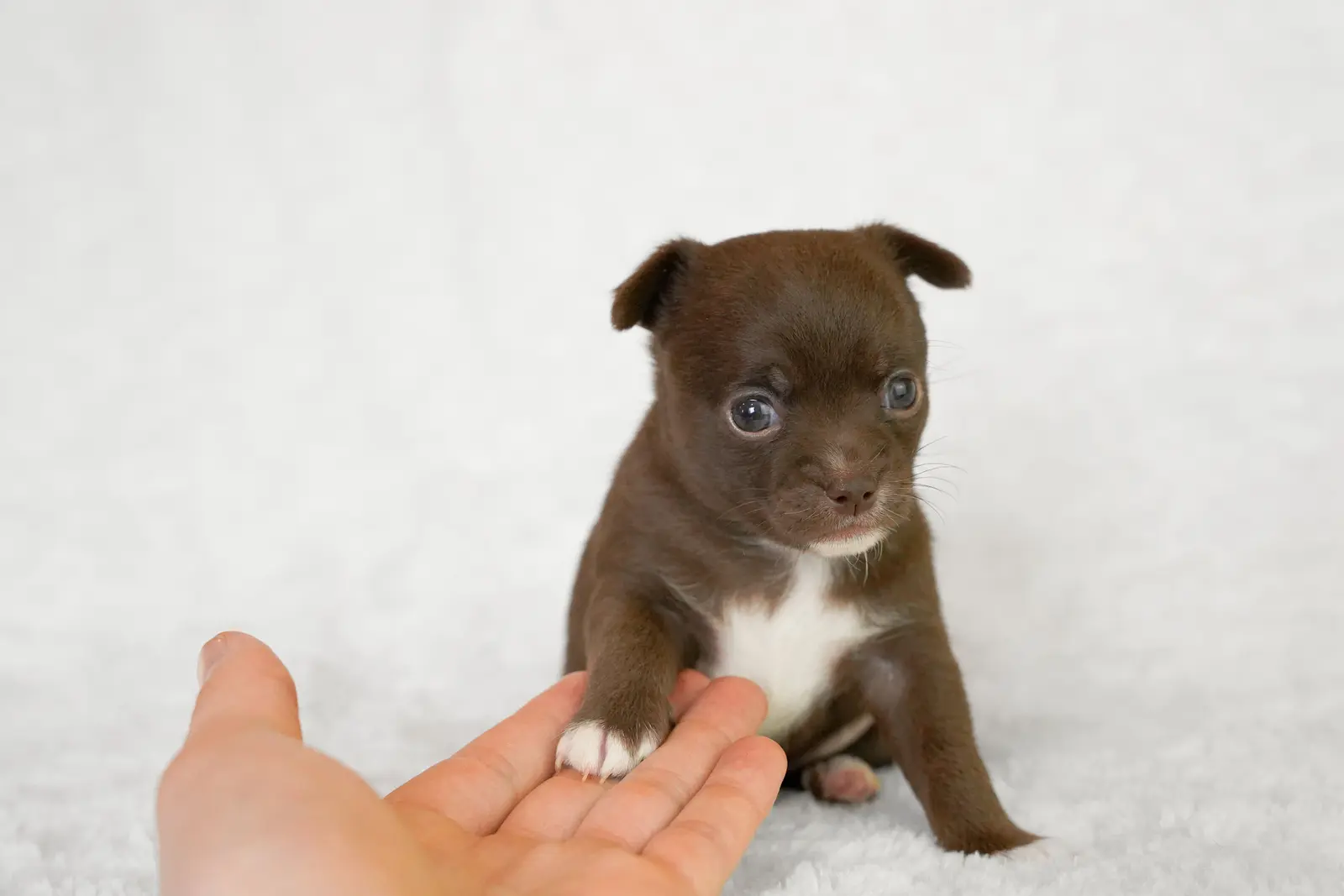
The first eight weeks of a puppy's life are some of the most important. During this time, thoughtful breeders can help shape confidence, resilience, and adaptability through age-appropriate enrichment and socialization. While genetics lay the foundation, early experiences help puppies prepare for life with their future families. Here's what current research tells us about making those weeks count.
Why the first 8 weeks matter
The science behind early puppy development is both fascinating and humbling for anyone who works with dogs. Being a dog breeder is a huge responsibility. Long before puppies go home, breeders are shaping the genetic, developmental, and learning histories that will influence how those puppies respond to the world.
In parts 1 and 2 of our Breeder Guide Series, we previously noted that breeders are responsible for setting up good developmental environments, knowing their breeds’ socialization windows and working within those to curate social opportunities, and introducing critical relevant experiences.
Let’s dig a little deeper into each of these categories.
Creating an Enriched Developmental Environment
Setting up a Solid Developmental Environment
Across species, young animals raised in boring, sterile, unchanging environments tend to become adults who are less behaviorally flexible, more uncertain about novelty, and less bold. There is not much research on this topic in puppies, but there is substantial research supporting this pattern in other species, including mice, rats, pigs, dairy cows, and birds.
One puppy enrichment study randomly assigned puppies to two groups: one group was a control group and received no intervention, but one group received “challenge” exercises, including novel objects, novel sounds, and brief isolation, between 3–6 weeks (Stolzlechner et al., 2022). When tested at 7 weeks, the puppies who were challenged had smaller startle responses to loud sounds and recovered more quickly. They were also more likely to approach and interact with novel objects as compared to the control group.
Unfortunately, there is not enough research to say exactly what breeders should do. This makes enrichment a little tough, because you want to make the environment interesting and challenging for your puppies, but not scary and unpredictable. So, how much enrichment is “just right”? To be honest, you’ll need to experiment a little bit and use your puppies’ behavioral responses as your guide. Some enrichment programs already exist, and many breeders find them useful. However, no specific branded enrichment program has been fully scientifically validated as a complete protocol, so I would treat these as sources of ideas rather than strict requirements:
- BioSensor (Early Neurological Stimulation), aka the “Super Dog” Program – we’ll discuss the mixed results from these studies in a few weeks! https://www.extension.purdue.edu/extmedia/VA/VA-24-W.pdf
- Puppy Culture https://shoppuppyculture.com/
- Avidog https://shop.avidog.com/
- Early Socialization Project (for working dogs) https://www.iwdba.org/working-dog-resources/early-socialization-project-introduction/ v2026-08-06 Of course, enrichment and socialization do not erase genetics. The Stolzlechner et al. study also concluded that genetics played a substantial role in behavioral outcomes, regardless of the socialization provided. In other words: genetics first, then environment.
Understanding Breed Differences and Socialization Windows
Knowing Your Breed: Quirks, Socialization Windows, Future Work
Before we discuss how to curate structured social opportunities for your puppies, it’s important to understand your breed’s typical socialization window, behavioral tendencies, and social preferences. For example, one super interesting study showed that German Shepherd puppies start exhibiting fear-related avoidance behaviors around 5.5 weeks old and Yorkshire Terriers start at 6 weeks, whereas Cavalier King Charles Spaniel puppies start showing fear behaviors much later at almost 8 weeks old (Morrow et al., 2015)!
This means that breeders of German shepherds and Yorkshire terriers have a much smaller socialization window and absolutely must start enrichment and socialization early. Some breeds and even lines will be much more sensitive to novelty, certain types of stimulation (e.g., sounds vs. sights vs. smells), other dogs, new people, etc. (Salonen et al., 2020). For example, Wheaten Terriers, Rough Collies, and Staffordshire Bull Terriers have higher rates of fear of thunder than Labradors.
To summarize this, know the genetic tendencies of the dogs you are breeding. This can be especially challenging for breeders working with mixed-breed dogs, such as doodles, or for breeders who frequently change breeding pairs or lines. Therefore, asking the owners of your breeding pairs these questions will be critical.
Introducing Critical Early Experiences
Carefully Introducing Critical Relevant Experiences
First, knowing where puppies in your breed tend to struggle behaviorally will be helpful; this gives you information on what behavioral skills you may need to intentionally support. It’s also helpful to have a good understanding of what your puppies are expected to do upon rehoming. If you know that most of your puppies are going to become gun dogs and therefore must be comfortable with loud or nature-based sounds, you may want to focus your efforts heavily on auditory stimuli.
Once you know what general needs to focus on, you can create a list of critical relevant experiences your puppies may need. The goal is not to expose every puppy to everything. The goal is to identify the experiences most likely to matter for that puppy’s future life. This may include things like:
- Dog-dog socialization for breeds who tend toward dog reactivity
- Human socialization for breeds more likely to engage in human aggression
- Novel environments, objects, and people for breeds tending to exhibit fear or anxiety-related responses
- Safe, supervised exposure to target livestock species for livestock guardian dogs
Other experiences I think are relevant for all puppies include the following daily experiences:
- Off-leash foundations: In a safe, enclosed area, reinforce the puppy for moving toward you, orienting to you, and following your movement, especially during brief outdoor walks.
- Body handling: The puppy is gently handled all over its body and reinforced heavily for relaxed body language, stillness, or voluntary engagement. If the puppy is panicking or squirming, handling should be made less aversive or briefer. v2026-08-06
- Nail trimming: The puppy’s paws and nails are gently handled. Both nail clippers and a Dremel can be introduced daily, even if they do not actually cut the nail—definitely don’t cut every day! Heavy reinforcement is given for calm behaviors.
- Avoiding resource guarding: As the puppy gets comfortable, the breeder can occasionally practice brief trades, ensuring the puppy receives something better and gets the original resource back afterward. Never remove any items from the puppy’s mouth unless it’s an emergency, as that might cause increased guarding.
- Novel objects: Puppies should experience at least one novel object in a known environment every day, especially household objects such as brooms, vacuums, and parked cars.
- Human social interactions: This includes new people, but also working to get your puppies used to people with different sexes/genders, hairstyles, heights/weights, ages, movement styles, skin colors, voices, clothing, and accessories.
The Value of Early Enrichment
A Side Note on Effort and Money
If you offer excellent genetics, enrichment, and training experiences, that means you are putting in a lot of effort and time, including educating yourself. Make sure to charge accordingly. Every good breeder I’ve talked to says that you don’t make money breeding puppies, but you should at least cover your baseline costs and get compensated for your time.
What you can charge will depend on your location, breed, typical medical care and testing costs, supplies/equipment, and the outcomes of your adult dogs (e.g., CGC, titles), but your fee should also account for the effort of enrichment and socialization. Therefore, don’t forget to factor those in.
Final Thoughts
Providing enriched environments and structured, relevant experiences is a tremendous amount of work. But if you do it well, you can feel good knowing that you made a huge difference in the lives of your puppies and their families.
Next month, we’ll provide a detailed checklist that covers all the most important and general environments, stimuli, and activities necessary for typical puppies.
FAQs
Q: What is a puppy socialization checklist?
A: A puppy socialization checklist helps breeders introduce age-appropriate experiences that build confidence and prepare puppies for life with their future families.
Q: When should puppy socialization begin?
A: Safe, developmentally appropriate socialization begins during the first weeks of life and continues throughout puppyhood. Experiences should always match the puppy's age and comfort level.
Q: Should puppies experience everything before 8 weeks?
A: No. The goal is not to expose puppies to everything. Instead, breeders should provide gradual, positive experiences based on the puppy's breed, temperament, and likely future lifestyle.
Q: How do I know if a puppy is becoming overwhelmed?
A: Signs such as prolonged freezing, hiding, repeated startling, refusing food, or being unable to recover indicate the experience was too intense and should be made easier.
Q: What sounds should puppies hear before going home?
A: Household sounds such as doorbells, vacuums, dishwashers, washing machines, traffic, children playing, and other everyday noises introduced gradually at low intensity.
Q: Why is handling important for puppies?
A: Gentle handling helps prepare puppies for grooming, nail trims, veterinary exams, and everyday care while building positive associations with touch.
Q: Should every breed receive the same socialization?
A: No. Socialization should be tailored to the breed's typical temperament, future role, and expected home environment.
Q: Is puppy socialization the same as enrichment?
A: Not exactly. Socialization focuses on positive exposure to people, animals, and environments, while enrichment encourages exploration, problem-solving, and confidence through novel experiences.
About Puppies.com
At Puppies.com, we're proud to support responsible breeders who lead with integrity, transparency, and a commitment to healthy, well-socialized puppies. Have questions or need support? Our team is always here to help.
Since 2003, Puppies.com has helped connect millions of puppies with loving families across the country. Finding your perfect puppy is free and easy, and creating an account only takes a few minutes.
Add a little wiggle to your life!®
References
Morrow, M., Ottobre, J., Ottobre, A., Neville, P., St-Pierre, N., Dreschel, N., & Pate, J. L. (2015). Breed-dependent differences in the onset of fear-related avoidance behavior in puppies. Journal of Veterinary Behavior: Clinical Applications and Research, 10(4), 286–294. https://doi.org/10.1016/j.jveb.2015.03.002
Salonen, M., Sulkama, S., Mikkola, S., Puurunen, J., Hakanen, E., Tiira, K., Araujo, C., & Lohi, H. (2020). Prevalence, comorbidity, and breed differences in canine anxiety in 13,700 v2026-08-06 Finnish pet dogs. Scientific Reports, 10, 2962. https://doi.org/10.1038/s41598-020-59837-z
Stolzlechner, L., Bonorand, A., & Riemer, S. (2022). Optimising puppy socialisation–short- and long-term effects of a training programme during the early socialisation period. Animals, 12(22), 3067. https://doi.org/10.3390/ani12223067